OBRA Requirements for CNA: What You Need to Know
Published October 6, 2026
If you're pursuing a career as a Certified Nursing Assistant (CNA), you've likely encountered the term OBRA requirements for CNA. These federal mandates set the standard for nurse aide training and certification across the United States. Understanding OBRA helps you choose a quality program, prepare for your exam, and know your rights as a future CNA.
What Is OBRA and Why Does It Matter for CNAs?
The Omnibus Budget Reconciliation Act (OBRA) of 1987 is a federal law that established minimum training and competency evaluation requirements for nursing assistants working in Medicare- and Medicaid-certified nursing homes. Before OBRA, training varied widely, and there were no consistent standards. OBRA changed that by requiring states to implement Nurse Aide Training and Competency Evaluation Programs (NATCEP). Today, these requirements ensure that CNAs are properly trained to provide safe, high-quality care.
Key OBRA Requirements for CNA Certification
To work as a CNA in a federally funded facility, you must meet specific OBRA criteria. Here are the core requirements:
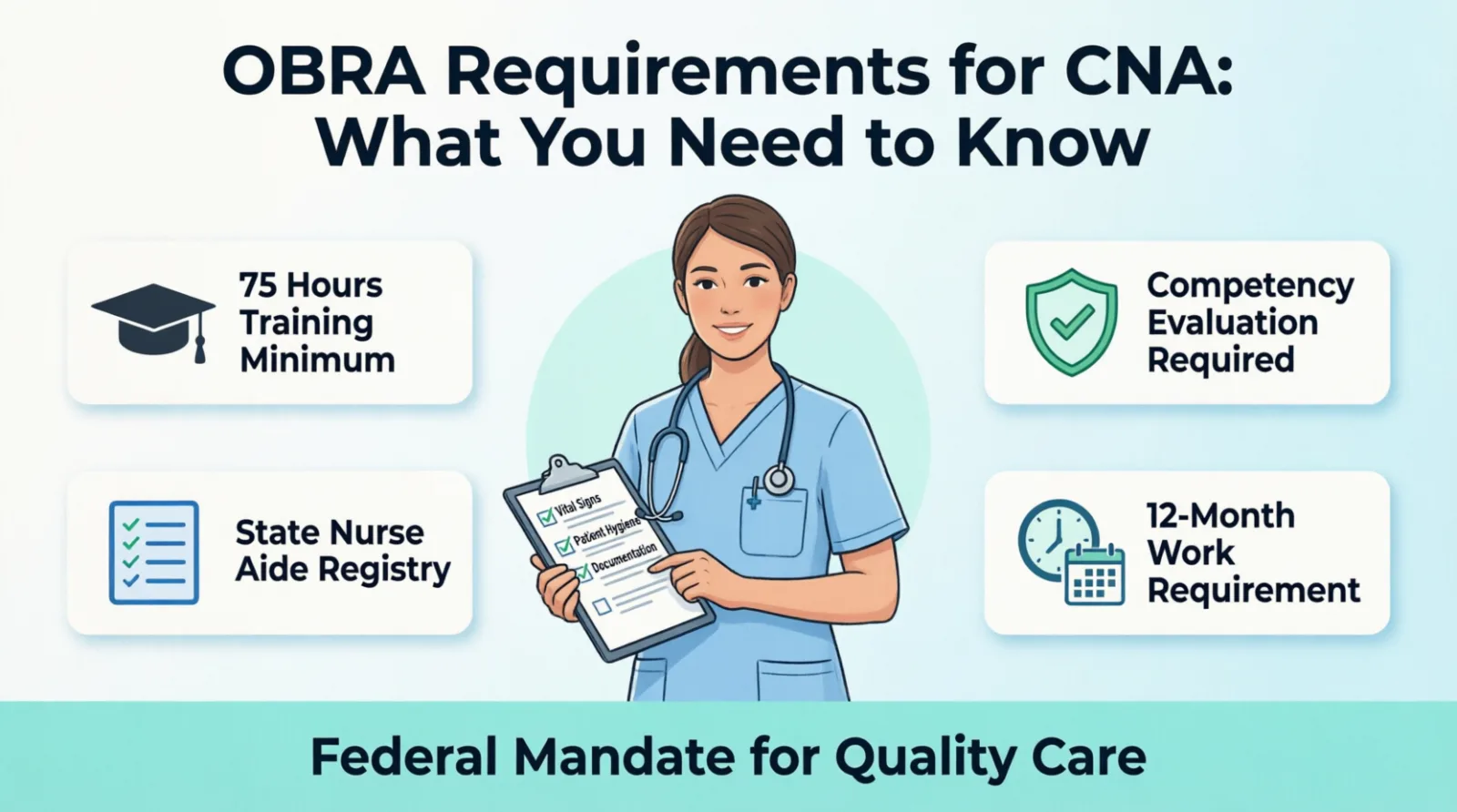
- Minimum Training Hours: At least 75 hours of state-approved training, including classroom instruction and supervised clinical experience.
- Competency Evaluation: You must pass both a written (or oral) exam and a skills demonstration to prove your knowledge and hands-on abilities.
- Registry Listing: Your name must be added to your state's nurse aide registry, which verifies your certification status.
- Continuing Education: Many states require 12 hours of in-service training per year to maintain active status.
- Background Checks: You must pass a criminal background check and meet any state-specific disqualification rules.
Training Program Content
OBRA mandates that training cover essential topics such as communication, infection control, safety, resident rights, basic nursing skills, and mental health care. Programs must also include a minimum of 16 hours of supervised clinical training in a nursing facility. This ensures you gain real-world experience before taking your exam.
Competency Evaluation Details
The competency evaluation consists of two parts: a written or oral test and a skills test. The written exam typically includes multiple-choice questions on topics like activities of daily living, safety, and infection control. The skills test requires you to perform specific nursing tasks while an evaluator observes. You must pass both portions to be listed on the registry.
How OBRA Affects State CNA Requirements
While OBRA sets the federal minimum, individual states can impose stricter requirements. For example, some states require more than 75 training hours or additional background checks. Always check with your state's nurse aide registry for exact rules. OBRA also requires that states maintain a registry of all certified nurse aides, including any findings of abuse or neglect.
If you're preparing for your competency exam, understanding the format can help. Our state-based CNA practice exams mirror the real test, covering OBRA-mandated topics so you can study efficiently.
Why OBRA Requirements Matter for Your Career
OBRA ensures that all CNAs receive consistent, high-quality training. This benefits you as a job seeker because employers know you've met rigorous standards. It also protects residents by ensuring that caregivers are competent and knowledgeable. Additionally, OBRA gives you the right to work in any Medicare- or Medicaid-certified facility once you're certified, provided you meet state reciprocity rules.
How to Meet OBRA Requirements
- Enroll in a state-approved CNA program: Ensure the program meets OBRA's 75-hour minimum and includes clinical training.
- Complete the training: Attend all classes and clinical rotations, and pass any internal assessments.
- Apply for the competency exam: Contact your state's testing provider (e.g., Pearson VUE or Prometric) to schedule your written and skills tests.
- Pass both exams: Use study resources like our free CNA practice test with answers to prepare.
- Get listed on the registry: Once you pass, your name will be added to your state's nurse aide registry.
For more detailed guidance on the competency exam, see our CNA competency exam guide.
Frequently Asked Questions
Do OBRA requirements apply to all CNAs?
OBRA requirements apply to nurse aides working in Medicare- and Medicaid-certified nursing facilities. If you work in a hospital or home care setting, state or employer requirements may differ, but many follow OBRA standards.
Can I transfer my CNA certification to another state?
Most states allow reciprocity if you meet OBRA requirements and are in good standing on your original state's registry. You may need to pay a fee and submit verification.
What happens if I fail the competency exam?
You can retake the exam, but states often limit the number of attempts and may require additional training. Check your state's rules for specifics.
For authoritative details, refer to the Centers for Medicare & Medicaid Services (CMS) and your state's nurse aide registry.
OBRA requirements are the foundation of CNA certification. By choosing an approved program and preparing thoroughly for your exams, you'll be well on your way to a rewarding career in healthcare.