OSHA for CNAs: Workplace Safety Rules Explained
Published October 7, 2026
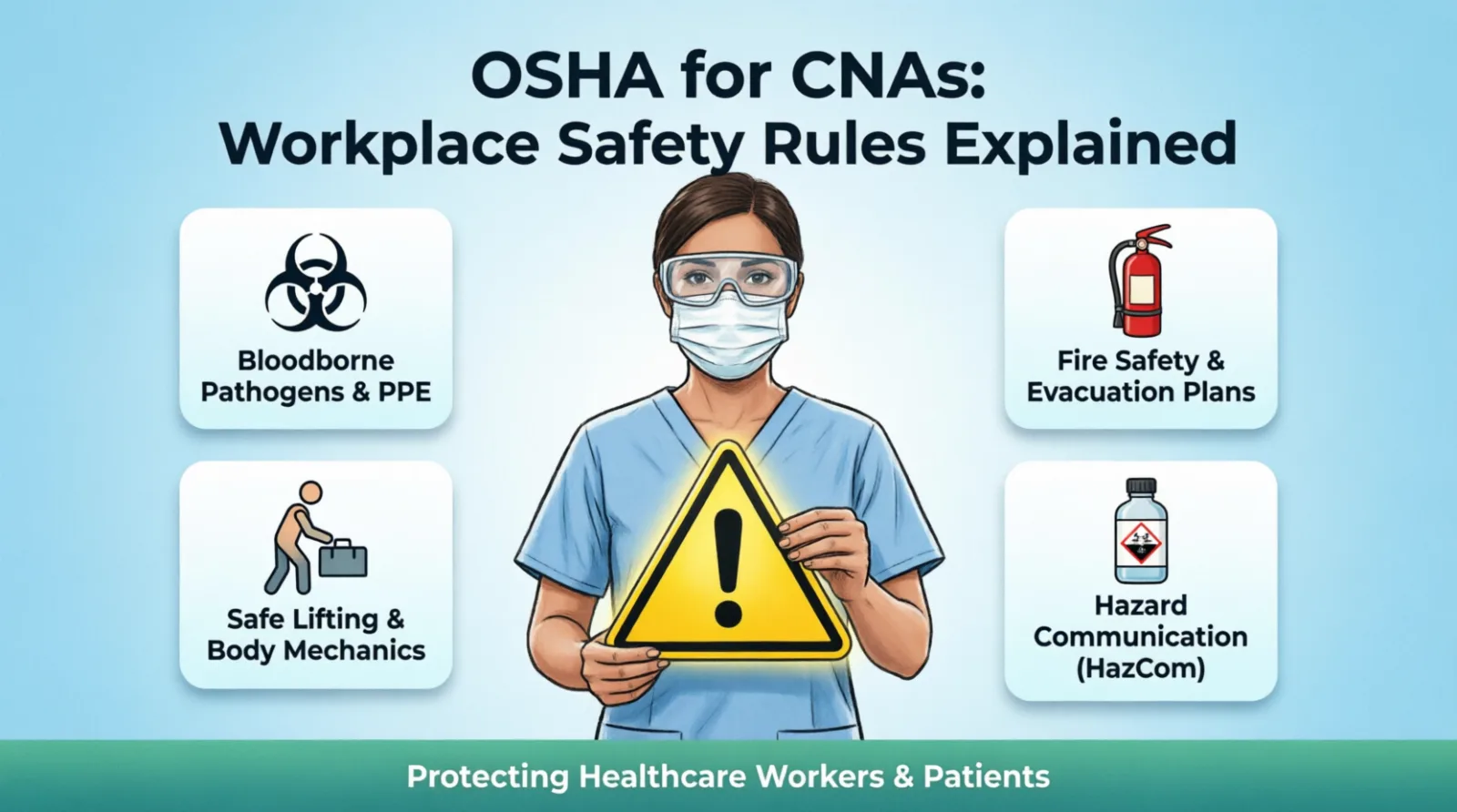
If you're a CNA or studying to become one, you've likely heard the acronym OSHA. The Occupational Safety and Health Administration sets and enforces workplace safety rules that directly affect your daily work, from handling blood and body fluids to lifting patients and dealing with hazardous chemicals. Understanding OSHA not only keeps you safe but also helps you answer exam questions about safety and infection control.
What Is OSHA and Why Does It Matter for CNAs?
OSHA is a federal agency under the U.S. Department of Labor. Its mission is to ensure safe and healthful working conditions by setting and enforcing standards and by providing training, outreach, education, and assistance. For CNAs, OSHA regulations are not optional, employers must comply, and you must follow them to protect yourself, your coworkers, and your patients.
OSHA rules apply to most healthcare settings, including nursing homes, hospitals, assisted living facilities, and home care agencies. As a CNA, you'll encounter OSHA standards in areas like infection control, personal protective equipment (PPE), safe patient handling, and hazard communication.
Key OSHA Standards Every CNA Should Know
Bloodborne Pathogens Standard (29 CFR 1910.1030)
This is perhaps the most critical OSHA standard for CNAs. It requires employers to:
- Provide a written exposure control plan.
- Offer free hepatitis B vaccination to employees with occupational exposure risk.
- Supply appropriate PPE (gloves, gowns, masks, eye protection) at no cost.
- Provide training on bloodborne pathogens at initial assignment and annually thereafter.
- Ensure proper handling and disposal of sharps and regulated waste.
As a CNA, you must follow standard precautions, treating all blood and body fluids as potentially infectious. This includes hand hygiene, using gloves for anticipated contact, and never recapping needles. For a deeper dive into infection control practices, see our CNA infection control exam tips.
Hazard Communication Standard (29 CFR 1910.1200)
Also known as the "Right to Know" law, this standard ensures you understand the chemicals you work with. Employers must:
- Maintain a list of hazardous chemicals in the workplace.
- Ensure containers are labeled with hazard warnings.
- Provide Safety Data Sheets (SDS) for each chemical.
- Train employees on safe handling and emergency procedures.
As a CNA, you may use disinfectants, cleaning agents, and other chemicals. Always read labels, follow dilution instructions, and wear PPE as required. If you have questions, ask your supervisor or consult the SDS.
Safe Patient Handling and Mobility
While OSHA does not have a specific standard for safe patient handling, it provides guidelines and enforcement through the General Duty Clause. Many states have additional safe patient handling laws. OSHA recommends:
- Using mechanical lifts and transfer aids whenever possible.
- Assessing the patient's mobility and the environment before lifting.
- Training on proper body mechanics and lift equipment.
- Encouraging teamwork for heavy lifts.
Following these practices reduces your risk of musculoskeletal injuries, which are common among nursing assistants. For more on safe mobility, check out our CNA mobility skill questions PDF.
Other Relevant OSHA Standards
- Personal Protective Equipment (29 CFR 1910.132-138): Employers must provide and pay for PPE, and you must use it correctly.
- Respiratory Protection (29 CFR 1910.134): If you use N95 respirators, you must be medically evaluated, fit-tested, and trained.
- Exit Routes and Emergency Action Plans (29 CFR 1910.35-38): Know your facility's evacuation procedures and where to go in an emergency.
How OSHA Affects Your CNA Exam and Daily Work
OSHA concepts appear on the CNA written exam, especially in the areas of safety, infection control, and emergency response. Questions may ask about the correct order for donning and doffing PPE, when to wash hands, or what to do if a fire occurs. Understanding OSHA standards helps you answer these correctly and prepares you for real-world scenarios.
On the job, OSHA compliance is everyone's responsibility. If you see a hazard, such as a wet floor, a malfunctioning lift, or a missing SDS, report it to your supervisor immediately. You have the right to a safe workplace, and your employer has a duty to provide one.
For a broader overview of safety and safety-related exam topics, explore our Promotion of Safety CNA practice test.
Your Rights and Responsibilities Under OSHA
As a CNA, you have the right to:
- Receive training on workplace hazards in a language you understand.
- Access your medical and exposure records.
- Request an OSHA inspection if you believe there is a serious hazard.
- Report a work-related injury or illness without retaliation.
Your responsibilities include following safety rules, using PPE correctly, reporting hazards, and participating in training. Remember, OSHA protects you—but only if you actively participate in your own safety.
Where to Learn More
For official information, visit the OSHA Healthcare page, which offers resources specific to nursing homes and other healthcare settings. The CDC's NIOSH Healthcare Safety and Health topic page also provides valuable guidance on preventing injuries and infections.
If you're preparing for your CNA exam, understanding OSHA regulations gives you a solid foundation in safety and infection control. Practice with realistic questions to reinforce your knowledge. Our CNA knowledge exams cover these topics and more, helping you build confidence for test day.